Latest Science & Research News

Stay informed about scientific discoveries, research developments and new findings from around the world.

Latest News

View All →
Microcrystal electron diffractometer brings hidden hydrogen into focus
Science News

Microcrystal electron diffractometer brings hidden hydrogen into focus

Hydrogen—the lightest atom—does the heavy lifting when it comes to important chemical reactions. It can be stored and released as clean fuel, and its movements help catalysts build medicines, fertilizers and materials. One way hydrogen is available for use is through a hydride—a hydrogen (H) atom bound to a metal. Yet with standard tools, this metal-bound atom can be hard to find in the structure.

📅 2026-09-22 17:20:05    •    Phys.org
Read Original Article →
VR boosts English vocabulary scores for students with dyslexia, pilot study finds
Science News

VR boosts English vocabulary scores for students with dyslexia, pilot study finds

Virtual reality (VR) could be a new tool to help students with dyslexia learn English vocabulary more effectively than conventional instruction alone, according to a pilot study involving 30 learners published in the International Journal of Innovation and Learning. Dyslexia is a learning disability that primarily affects reading and related language skills.

📅 2026-09-22 17:20:04    •    Phys.org
Read Original Article →
Vera C. Rubin Observatory detects one of the smallest and faintest satellite galaxies ever seen
Science News

Vera C. Rubin Observatory detects one of the smallest and faintest satellite galaxies ever seen

In one of the first major discoveries from the Vera C. Rubin Observatory in Chile, scientists have revealed a previously unknown galaxy orbiting the Milky Way. Described in a study that hasn’t been peer-reviewed, the galaxy, named Aquarius IV, is one of the lightest, faintest and farthest satellite galaxies ever seen. This dim cluster of ancient stars was discovered on the extreme periphery of the Milky Way in early test data from the Rubin Observatory, offering a glimpse of the telescope's impressive abilities and shedding new light on our cosmic neighborhood. Ultrafaint dwarf galaxies (UFDGs) are among the tiniest and faintest galaxies in the universe. These dim little clusters contain at ...

📅 2026-09-22 17:12:25    •    Live Science
Read Original Article →
Antibiotic resistance research calls for tests that reflect bacteria's changing environments
Science News

Antibiotic resistance research calls for tests that reflect bacteria's changing environments

The World Health Organization (WHO) regards antimicrobial resistance, including antibiotic resistance, as one of the world's major health challenges. A new fundamental understanding of antibiotic resistance could therefore potentially have a far-reaching impact on global public health, animal health and the environment.

📅 2026-09-22 17:00:07    •    Phys.org
Read Original Article →
Astronomers detect radio signals coming from an exoplanet for the first time
Science News

Astronomers detect radio signals coming from an exoplanet for the first time

Exoplanets are exotic worlds orbiting distant stars far beyond our solar system. Ever since the first ones were discovered in the 1990s, astronomers have turned their attention to these distant worlds to understand more about them. Now, for the first time, scientists have detected radio signals coming directly from one of these planets, a massive gas giant named β Pictoris b.

📅 2026-09-22 16:40:07    •    Phys.org
Read Original Article →
US heading for unprecedented El Niño winter: Here's what to expect
Science News

US heading for unprecedented El Niño winter: Here's what to expect

The ongoing El Niño is breaching the "super" threshold as Earth crosses into unprecedented climate territory. El Niño, officially underway as of June 11, is a climate pattern that's injecting extra heat into our already-warming world, threatening disruptive weather across the globe and a humanitarian crisis in some regions.While El Niño is part of a natural multiyear climate cycle, scientists have noticed that it has been rapidly strengthening like never before, intensified by human-driven climate change, and putting stressed natural systems under extra strain.In a new update this week, the National Oceanic and Atmospheric Administration's (NOAA) Climate Prediction Center continues to foreca...

📅 2026-09-22 16:08:06    •    Live Science
Read Original Article →
3I/ATLAS has an extreme taste for heavy water
Science News

3I/ATLAS has an extreme taste for heavy water

More and more details about 3I/ATLAS are filtering through the scientific process as time goes on. Our third known interstellar visitor attracted the attention of some of the world's most powerful observatories when it was discovered in July 2025, and some of those telescopes found something peculiar—the isotopes it contained appeared different. A new paper submitted to The Astrophysical Journal Letters (and available as a preprint on arXiv) by Kenji Furuya of the RIKEN Pioneering Research Institute in Japan and his co-authors shows that the isotopic discrepancy is likely due to the "low metallicity" of the stellar nursery in which 3I/ATLAS was born.

📅 2026-09-22 16:00:01    •    Phys.org
Read Original Article →
Scientists identify 'sweet spot' for early stage of life on Earth that preceded LUCA, the ancestor of all living things
Science News

Scientists identify 'sweet spot' for early stage of life on Earth that preceded LUCA, the ancestor of all living things

Scientists have identified a "sweet spot" in Earth's deep past when conditions were optimal for a proposed early stage of life to take hold — a phase known as the RNA World.The sweet spot was 4.33 billion years ago, although Earth may have become suitable for the RNA World as early as 4.4 billion years ago, given that extreme bombardment by asteroids, comets and other rocky leftovers of planet formation had largely stopped by then, the researchers reported in a study published Tuesday (Sept. 22) in the journal Nature Communications.The findings give a more precise estimate of the RNA World's onset than previous studies based on geochemical modeling, biomolecular analyses and simulations of e...

📅 2026-09-22 15:47:28    •    Live Science
Read Original Article →
Methane beneath the Greenland ice sheet shapes microbial life and influences the carbon cycle
Science News

Methane beneath the Greenland ice sheet shapes microbial life and influences the carbon cycle

A new study involving researchers from the Faculty of Science, Charles University, Prague, shows that methane concentration is among the key factors determining the composition of microbial communities at the margin of the Greenland Ice Sheet. The findings, published in Applied and Environmental Microbiology, provide new insights into processes that influence carbon and methane cycling in a rapidly warming Arctic.

📅 2026-09-22 15:40:04    •    Phys.org
Read Original Article →

Milky Way's first microblazar may produce fastest particles in the galaxy
Science News

Milky Way's first microblazar may produce fastest particles in the galaxy

An international team of astronomers from ASTRON, JIVE, the University of Amsterdam and other institutions has found the first so-called "microblazar" in the Milky Way. This stellar system is composed of a massive star and a black hole with a jet that is pointed toward Earth. The researchers also identified the region where the jet hits a molecular cloud as a place where particles are accelerated to ultra-high energies, likely up to petaelectronvolts. This would make microblazars one of the most powerful particle accelerators in the galaxy. The research was appears in Astronomy & Astrophysics.

📅 2026-09-22 15:40:01    •    Phys.org
Read Original Article →
The tilt in Earth's axis makes the apparent position of continents shift with the seasons
Science News

The tilt in Earth's axis makes the apparent position of continents shift with the seasons

Most kids learn in elementary school that the seasons are caused by Earth rotating on a tilted axis during its yearly orbit around the sun. The substantial tilt, about 23.5 degrees, is thought to be the result of an ancient planetary body, Theia, smashing into Earth about 4.5 billion years ago, in the same cataclysmic collision that formed the moon.

📅 2026-09-22 15:20:02    •    Phys.org
Read Original Article →
Giant caves beneath sinkhole reveal origin of mystery trenches that score Australia's Nullarbor Plain
Science News

Giant caves beneath sinkhole reveal origin of mystery trenches that score Australia's Nullarbor Plain

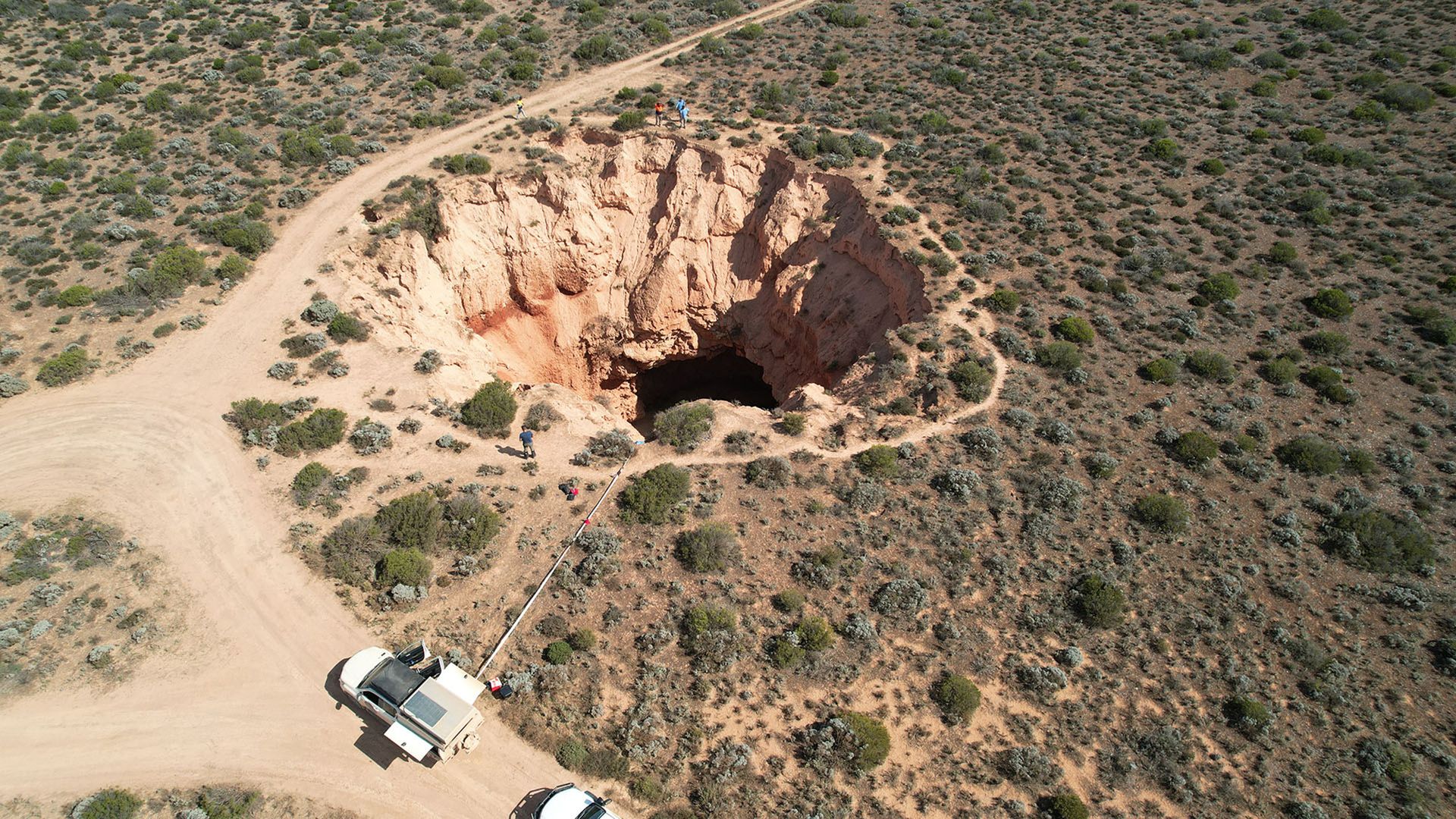
Mysterious trenches stretching for miles across the vast Nullarbor Plain in Australia are the surface scars of huge ancient caves collapsing deep underground, according to new research."They look like some kind of river channel, but they start and end so abruptly that it triggered us to investigate them," Matej Lipar, a researcher at the Anton Melik Geographical Institute in Slovenia and first author of the study, told Live Science.The Nullarbor Plain is an arid, flat, almost-treeless expanse in southern Australia. Nestled between the Great Victoria Desert and the Great Australian Bight coast, it has existed for more than 14 million years. Along the eastern edge of the Nullarbor Plain are fi...

📅 2026-09-22 14:12:18    •    Live Science
Read Original Article →
Page 100of 174   •   4,166articles