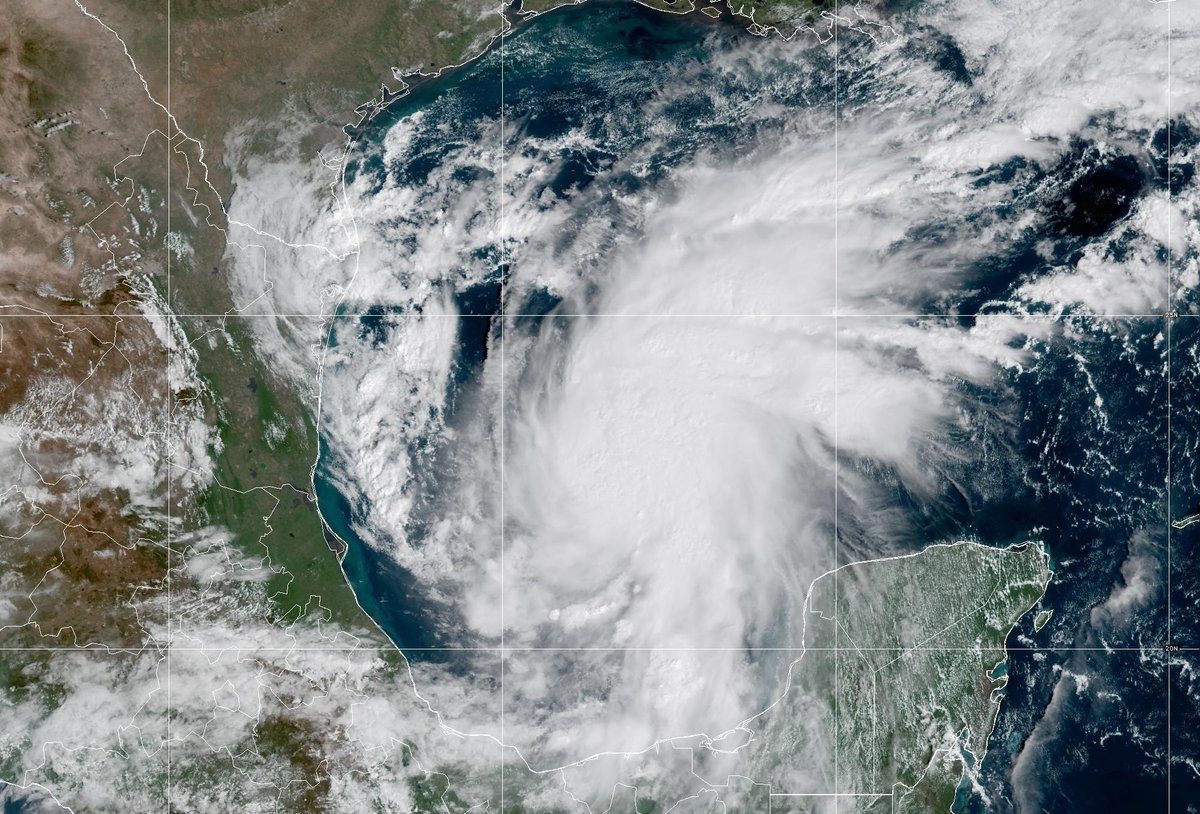
Hurricane Isaias shows ‘it only takes one’ to wreak havoc after historically calm Atlantic hurricane season
The Category 2 storm spawned tornadoes, flooding and extreme rain when it made landfall
Explore the latest scientific discoveries, science news, breakthroughs and developments from around the world.
The Category 2 storm spawned tornadoes, flooding and extreme rain when it made landfall
Researchers from the University of Amsterdam and Leiden University have discovered that humans and songbirds use markedly different strategies to recognize sequences of complex sounds. The findings shed new light on how biology and experience shape the way we perceive complex sounds, with implications for music and speech.
Scientists are harnessing the power of artificial intelligence (AI) to measure people's biological ages. Unlike chronological age, or the number of years a person has been living, biological age should reflect how well a person's bodily systems are working. Someone with a higher biological age has a higher risk for age-related diseases, such as cancer or dementia, than a person with a younger biological age. While some AI clocks look at epigenetic markers, others focus on other features, like the pitch and pace of people's voices, to calculate a biological age. We recently asked our readers if they would trust such AI tools to measure their biological age. Over 170 people responded, with 44%...
When the coronavirus SARS-CoV-2 turned our world upside down, mRNA vaccines against COVID-19 brought a breakthrough. Their success established modified mRNA as a powerful foundation for vaccines and opened the way for new mRNA-based technologies, with potential applications ranging from vaccines against other infectious diseases to cancer immunotherapy.
The white-tipped feathers found in many chicken breeds may look like variations of the same decorative pattern, but new research shows that they do not all share the same genetic origin.
A concept from the field of quantum mechanics, spin is a property of particles that has no direct counterpart in everyday experience. Since the early 20th century, researchers have learned to manipulate it deliberately by means of precisely shaped electromagnetic pulses. This has resulted in two technologies that are widespread today: magnetic resonance imaging (MRI) is commonplace in hospitals, and nuclear magnetic resonance spectroscopy (NMR) is used to determine the structures of proteins and to develop new drugs. The mathematical framework of optimal control theory can be used to improve these technologies.
Researchers at the Oregon State University College of Science have developed a new electrochemical sensor for rapidly and accurately detecting a naturally occurring compound widely used in the food, beverage and fragrance industries.
One researcher tells Scientific American that the change would reduce transparency and risk politicizing the grant review process
The elegant curl of rose petals may be distinct among flowers—and math can explain why
Turning invisible is a handy superpower in fiction — we don’t see you, Sue Storm! — but the technology to make it work in real life has a way to go.
Rumors that OpenAI’s “Navier-Stokes” solution stole the work of two mathematicians may have been overblown
Flu season in the U.S. typically starts around late October or early November and peaks between December and February. But new data reveals that the current flu season is starting slightly earlier than normal. According to the Centers for Disease Control and Prevention (CDC), around 3.4% of respiratory samples tested for flu came back positive for the week of Sept. 26. That's around seven times the rate compared with the same week in 2025. Related stories'Universal' cancer vaccine heading to human trials could be useful for 'all forms of cancer'Trump's childhood vaccine order will threaten children's safety, even if it doesn't directly change policy'Universal' nasal-spray vaccine protects ag...