Science News

Latest science news, discoveries and scientific developments.

How eye-catching social media feeds steer attention toward misinformation
Science News

How eye-catching social media feeds steer attention toward misinformation

A research team led by Jiyoung Lee, a professor in the Department of Media and Communication, has worked with international researchers to uncover how visual contrast across social media feeds influences how quickly users spot visual misinformation.

πŸ“… 2026-10-13 22:20:09    β€’    Phys.org
Hawaiian coral tests reveal heat tolerance varies by species and location
Science News

Hawaiian coral tests reveal heat tolerance varies by species and location

As ocean temperatures rise, corals' ability to withstand and adapt to heat stress is critical for the future of coral reefs. Many reef-building corals already live near their upper thermal limits, making them vulnerable to bleaching and, with prolonged stress, mortality.

πŸ“… 2026-10-13 22:00:12    β€’    Phys.org
The politics of city rats: What urban rodents tell us about housing and sanitation
Science News

The politics of city rats: What urban rodents tell us about housing and sanitation

Rats are on the ballot in Canadian municipal elections this fall, with several political parties promising to tackle city rat problems. While rats may seem like a niche election issue, they can point to broader societal concerns about housing, public services and civic engagement.

πŸ“… 2026-10-13 22:00:01    β€’    Phys.org
Thwaites Glacier could contribute twice as much sea-level rise as previously projected
Science News

Thwaites Glacier could contribute twice as much sea-level rise as previously projected

A new ice sheet model developed by glaciologists at the University of California, Irvine and NASA's Jet Propulsion Laboratory projects that the melting of Thwaites Glacier in West Antarctica will contribute up to 30 millimeters (1.2 inches) of sea level rise by 2100β€”twice previous estimatesβ€”even without additional climate warming.

πŸ“… 2026-10-13 21:50:01    β€’    Phys.org
Could meditation reveal an SU(3) symmetry shared by the observer and the universe?
Science News

Could meditation reveal an SU(3) symmetry shared by the observer and the universe?

You sit down to meditate. A conversation returns, then thoughts. You bring your attention back to the breath. Sometimes, after many such returns, the effort eases. Thoughts lose their urgency, while awareness remains clear. Less occupies the mind, yet the moment still feels whole.

πŸ“… 2026-10-13 21:40:08    β€’    Phys.org
'Carpet' growth method yields long-sought 2D quantum material
Science News

'Carpet' growth method yields long-sought 2D quantum material

For decades, physicists have sought a practical two-dimensional topological insulator: an ultrathin material whose interior blocks electricity but whose edges conduct it. In ordinary wires, electrons constantly bounce off imperfections, losing energy. But along the edges of a 2D topological insulator, electrons with opposite spins travel in opposite directions, like cars in one-way lanes, so they rarely scatter and lose energy.

πŸ“… 2026-10-13 21:30:02    β€’    Phys.org
Liquid metal dealloying creates nanoporous silicon carbide at just 800Β°C
Science News

Liquid metal dealloying creates nanoporous silicon carbide at just 800Β°C

Silicon carbide (SiC) is a ceramic known for its excellent heat resistance and chemical stability, which makes it attractive for a wide range of applications like electronics, catalysts and energy-related materials. However, SiC generally requires high-temperature processing, and simultaneously forming and controlling porous structures at the nanometer scale remains challenging.

πŸ“… 2026-10-13 21:20:07    β€’    Phys.org
Faster molecular simulations identify promising diamond defects for quantum computers and sensors
Science News

Faster molecular simulations identify promising diamond defects for quantum computers and sensors

A faster way of finding the best diamond-based materials for quantum computers has been developed by a researcher at the U.S. Department of Energy's (DOE) Princeton Plasma Physics Laboratory (PPPL). The new approach has already identified promising materials for practical quantum sensors and computers that could one day transform scientific research as a whole. The research was recently published in the journal ACS Central Science and has already garnered attention from other experts in the field.

πŸ“… 2026-10-13 21:20:01    β€’    Phys.org
2,000-year-old burial found in Russia near a human sacrifice and a cup to ward off magical threats
Science News

2,000-year-old burial found in Russia near a human sacrifice and a cup to ward off magical threats

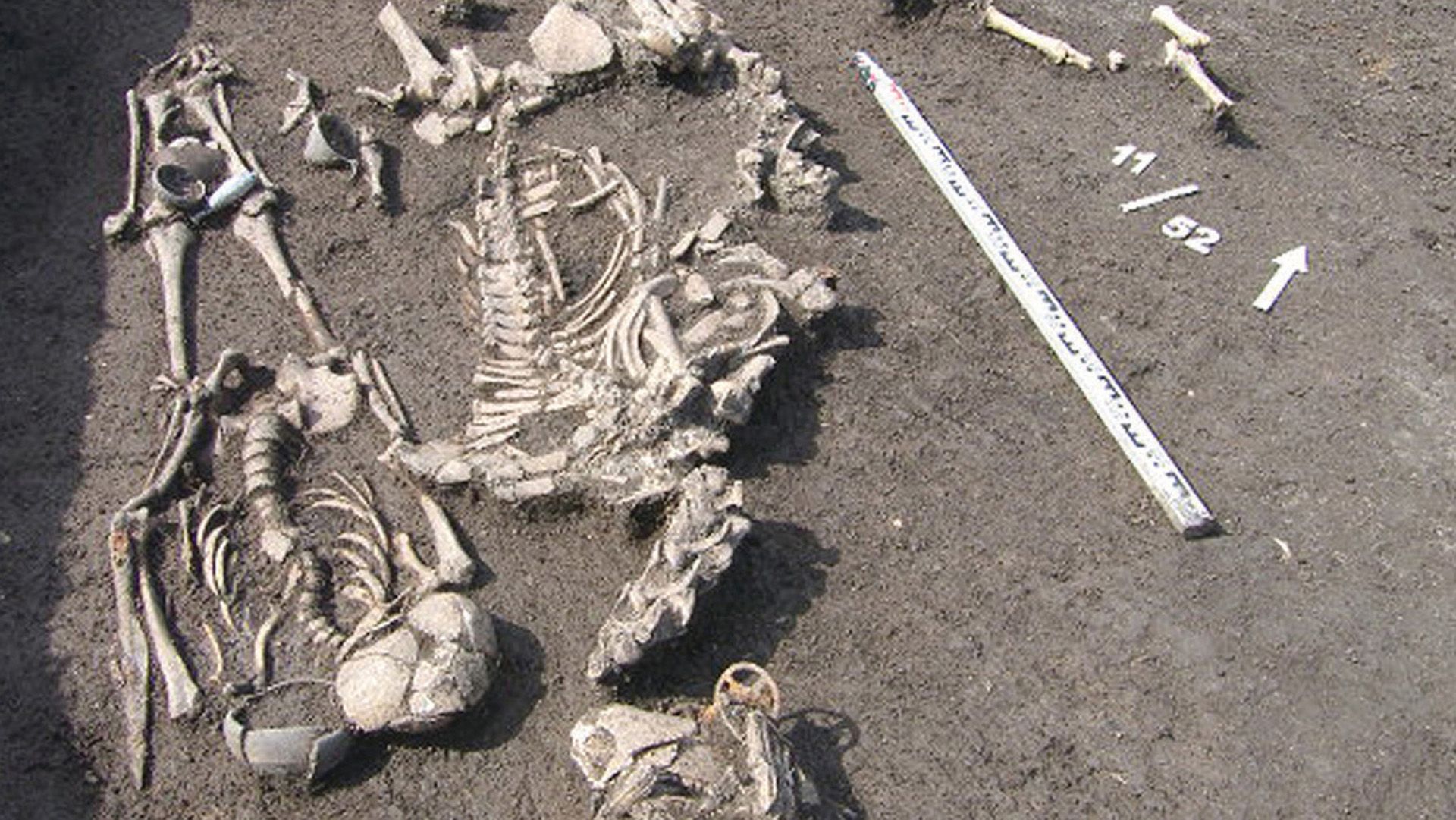
The warrior was buried with the remains of his weapons and his horse near the center of the ancient necropolis in the Kuban region near the Russian city of Krasnodar. (Image credit: Abramzon et al. 2015)Archaeologists in southern Russia have unearthed the 2,000-year-old grave of an elite warrior who was buried with his weapons, horse β€” and a human sacrifice. The grave and sacrifices were found with other lavish goods, including two gold coins featuring Alexander the Great.A team found the elite grave in Russia's Kuban region east of the Crimean Peninsula, in a necropolis of more than 150 ancient graves arranged around it. This central placement indicates the man had been a member of the soci...

πŸ“… 2026-10-13 21:10:41    β€’    Live Science
DNA 'flight recorder' traces embryonic development cell by cell
Science News

DNA 'flight recorder' traces embryonic development cell by cell

For decades, scientists have been able to look at individual moments in the development of an embryo: a snapshot of a developing brain, a picture of how the heart takes shape or a glimpse of cells beginning to form the nervous system.

πŸ“… 2026-10-13 21:00:06    β€’    Phys.org
New method helps researchers study proteins involved in plant health, disease
Science News

New method helps researchers study proteins involved in plant health, disease

Plantsβ€”like peopleβ€”come in all shapes and sizes. And just like scientists want to understand the components of the human body to treat disease and improve our lives, they also want to understand how plants thrive, develop disease, succumb or survive.

πŸ“… 2026-10-13 21:00:01    β€’    Phys.org
Humans and songbirds hear the same sounds, but organize them differently
Science News

Humans and songbirds hear the same sounds, but organize them differently

Researchers from the University of Amsterdam and Leiden University have discovered that humans and songbirds use markedly different strategies to recognize sequences of complex sounds. The findings shed new light on how biology and experience shape the way we perceive complex sounds, with implications for music and speech.

πŸ“… 2026-10-13 20:50:02    β€’    Phys.org
'I won't trust AI': Readers share mixed reaction to AI tools that calculate people's biological ages
Science News

'I won't trust AI': Readers share mixed reaction to AI tools that calculate people's biological ages

Scientists are harnessing the power of artificial intelligence (AI) to measure people's biological ages. Unlike chronological age, or the number of years a person has been living, biological age should reflect how well a person's bodily systems are working. Someone with a higher biological age has a higher risk for age-related diseases, such as cancer or dementia, than a person with a younger biological age. While some AI clocks look at epigenetic markers, others focus on other features, like the pitch and pace of people's voices, to calculate a biological age. We recently asked our readers if they would trust such AI tools to measure their biological age. Over 170 people responded, with 44%...

πŸ“… 2026-10-13 20:40:36    β€’    Live Science
Sequence changes help modified mRNA avoid protein-making errors to improve vaccine design
Science News

Sequence changes help modified mRNA avoid protein-making errors to improve vaccine design

When the coronavirus SARS-CoV-2 turned our world upside down, mRNA vaccines against COVID-19 brought a breakthrough. Their success established modified mRNA as a powerful foundation for vaccines and opened the way for new mRNA-based technologies, with potential applications ranging from vaccines against other infectious diseases to cancer immunotherapy.

πŸ“… 2026-10-13 20:40:07    β€’    Phys.org
Quantum physicists trace a century of controlling spin
Science News

Quantum physicists trace a century of controlling spin

A concept from the field of quantum mechanics, spin is a property of particles that has no direct counterpart in everyday experience. Since the early 20th century, researchers have learned to manipulate it deliberately by means of precisely shaped electromagnetic pulses. This has resulted in two technologies that are widespread today: magnetic resonance imaging (MRI) is commonplace in hospitals, and nuclear magnetic resonance spectroscopy (NMR) is used to determine the structures of proteins and to develop new drugs. The mathematical framework of optimal control theory can be used to improve these technologies.

πŸ“… 2026-10-13 20:30:01    β€’    Phys.org